



A custom pin backstamp is easy to overlook because it is not visible when the pin is worn. For brands, clubs, museums, and merchandise programs, however, that small area can carry important information about origin, ownership, authenticity, and future reorders.
The best backstamp is not simply the most detailed mark that fits. It is a production-ready system that remains legible after tooling, plating, post attachment, and normal wear. This guide explains the available processes, the practical limits of each option, and the decisions a buyer should document before approving production.
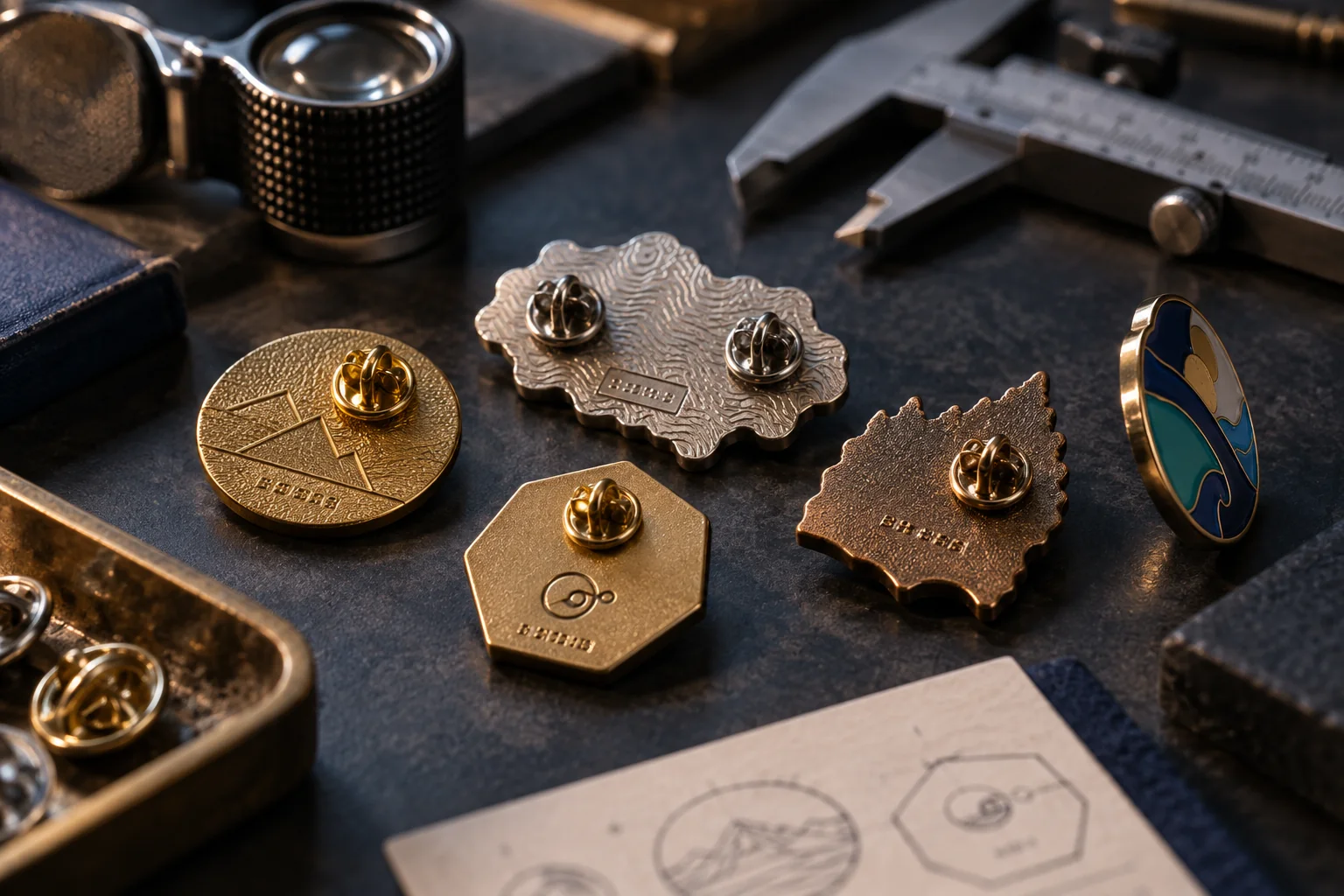
What Is a Custom Pin Backstamp?
A backstamp is a permanent or semi-permanent mark placed on the reverse of a lapel pin. Depending on the process, it may be built into the mold, engraved after plating, or printed onto the finished metal. Common content includes a company name, an abbreviated logo, a copyright line, a collection code, a country-of-origin statement, or an individual serial number.
The backstamp should be specified separately from the pin attachment. A butterfly clutch, rubber clutch, safety pin, or magnetic fitting secures the product; the backstamp identifies it. Both compete for space on the reverse, which is why the back design should be considered while the front artwork is still being engineered.
For buyers beginning a new program, the broader épingles personnalisées process still starts with size, metal, enamel style, plating, and quantity. The backstamp becomes part of that specification rather than an accessory added at the last minute.
Why Backstamps Matter in a B2B Pin Program
A backstamp can serve several business purposes at once:
- Brand continuity: a consistent maker mark connects products released in different seasons or sold through different channels.
- Provenance: a museum, artist, club, or event can identify an authorized edition without altering the front design.
- Inventory control: a small collection or SKU code helps staff distinguish visually similar versions.
- Licensing support: an ownership or copyright line may help document an approved merchandise program.
- Collector value: edition marks and controlled numbering create a clearer record of what was produced.
A backstamp is not a complete anti-counterfeiting system. A determined copyist can reproduce a simple mark. It does, however, increase the amount of production knowledge required to imitate an item and gives buyers, retailers, and collectors another point to inspect.
Choose the Right Marking Method
The four common approaches have different visual effects, cost structures, and artwork limits. The exact capability varies by factory and pin size, so dimensions should always be confirmed on the production proof.
| Method | Idéal pour | Main advantage | Key limitation |
|---|---|---|---|
| Raised mold mark | Logos and short brand names used on every unit | Durable and integrated into the metal tooling | Very fine details can close up or lose contrast |
| Recessed mold mark | Simple ownership lines, symbols, and collection codes | Clean, permanent impression with no added ink | Shallow marks may appear subtle on reflective plating |
| Laser engraving | Serial numbers, dates, QR-like identifiers, and variable data | Allows unit-level changes without revising the main mold | Contrast and tone vary with plating and laser settings |
| Printed back mark | Fine text or a dark, high-contrast mark | Can reproduce details that are difficult to mold | Less resistant to abrasion than a molded or engraved mark |
A molded mark is usually efficient when the same information appears on the entire run. Laser engraving is the practical choice when every piece needs a different number. Printing can solve a readability problem, but buyers should test rub resistance if pins will be handled frequently or packed without protective bags.
Raised vs. Recessed Backstamps
Raised marks
A raised backstamp is formed by recessing the corresponding area in the die, leaving the design above the surrounding metal on the finished pin. It catches light and can feel substantial, especially on antique or matte finishes. The tradeoff is that tall, narrow letters are vulnerable to filling in during polishing or appearing heavier than the original vector artwork.
Recessed marks
A recessed, or debossed, mark sits below the back surface. It is protected from some direct abrasion and works well for a compact symbol or short line. On highly polished gold or nickel, the impression may be visible mainly by shadow rather than by color. Antique finishing can increase apparent contrast because darker residue remains in the recessed areas.
Neither construction is universally better. The choice depends on the design, plating, and desired feel. Buyers comparing pin's en émail souple et pin's en émail dur should remember that the enamel style affects the front surface; the backstamp is primarily governed by the base metal, mold, plating, and finishing process.
Design for the Actual Usable Area
The outside dimensions of a pin are not the dimensions available for a backstamp. The usable area is reduced by post bases, recessed cavities, cutouts, edge bevels, moving parts, and safety clearances. A 1-inch round pin may offer a generous center, while a thin script-shaped pin of the same overall width may provide almost no continuous back surface.
Good backstamp artwork follows several principles:
- Use a simplified one-color vector design rather than a miniature copy of a multicolor front logo.
- Convert type to outlines and avoid hairline strokes, tight counters, and long legal sentences.
- Keep critical elements away from the outer edge and from welded post bases.
- Review the mark at final physical size, not only at 400% zoom on a monitor.
- Ask the manufacturer to flag any line or gap below its verified production limit.
There is no responsible universal minimum font size for every custom pin. Zinc alloy, struck brass, iron, and different engraving systems do not resolve detail in exactly the same way. Treat any generic minimum as an initial guideline, then make the factory confirm the engineered artwork for the chosen construction.
Plan Backstamps and Post Placement Together
The post is welded or otherwise attached to the reverse after the pin body is formed. Its base can cover part of a backstamp, distort nearby fine detail, or make a small line difficult to read. Large or elongated pins often need two posts to prevent rotation, reducing the open marking area further.
A complete digital proof should show the reverse view with:
- the backstamp at actual scale;
- every post center and attachment type;
- the direction in which the front design will sit when worn;
- any cutout, recessed area, or textured background;
- the selected plating and back texture.
This reverse view belongs in the same approval set as the front artwork. The custom pin artwork proof checklist provides a useful framework for checking dimensions, colors, plating, and hardware before a buyer signs off.
Serial Numbers and Limited Editions
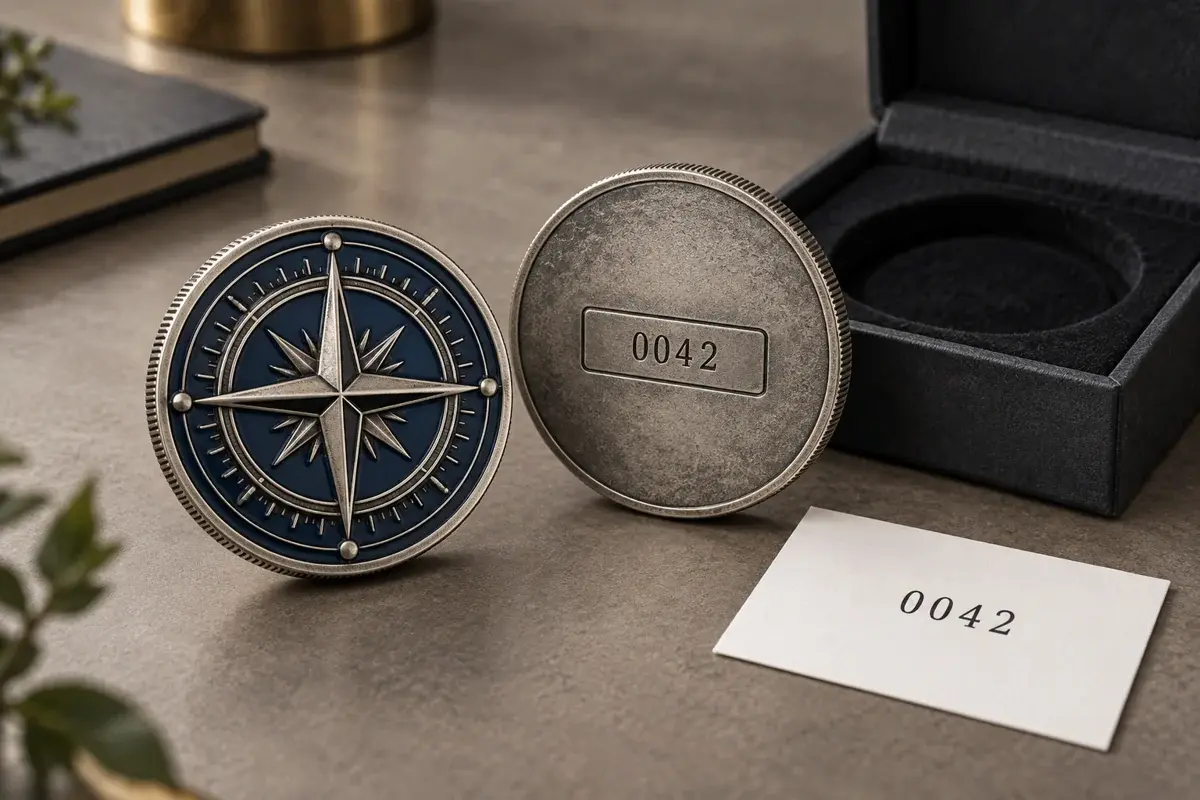
Individual numbering is usually added by laser after plating because a mold cannot economically change from one unit to the next. The fixed portion—such as “Edition of 500”—can be molded, while the variable sequence is engraved. If the edition number matters commercially, the purchase order should define more than the visible format.
Document the starting and ending numbers, leading zeros, duplicate policy, treatment of factory rejects, and whether replacement units may reuse a rejected number. Also decide whether samples and overrun pieces are numbered. Without these instructions, a nominal 500-piece edition can become ambiguous when setup samples, replacements, or quality-control rejects are considered.
Laser tone can range from dark gray to a subtle frosted mark depending on the metal and plating. Request a photo or physical pre-production sample under ordinary light. A dramatic close-up from one angle does not prove the number will be readable in normal handling.
Match the Mark to Metal and Finish
Backstamp visibility is a contrast problem. A deeply recessed mark may read clearly on antique brass but disappear into reflections on bright nickel. A laser mark that looks dark on one plating may appear pale on another. Sandblasted or textured backs can reduce glare, although aggressive texture can interfere with small characters.
Ask for the back construction in the written custom pin specification sheet. “Gold pin with logo on back” leaves too much open to interpretation. A better line item states the marking method, final backstamp dimensions, location, orientation, plating, back texture, and post coordinates.
Cost and Lead-Time Considerations
A fixed molded backstamp is often included in the primary tooling discussion, but complexity can affect die preparation. Laser numbering adds an operation after plating and usually carries a per-piece or batch charge. Printing requires setup, curing, and handling. A physical sample adds time but can prevent a much more expensive readability problem in bulk production.
Buyers should ask whether changing the backstamp requires a new mold. If the mark is part of the same die as the pin body, even a small copyright-year change may trigger new tooling. If annual changes are expected, a permanent molded brand mark plus laser-engraved year or collection code may be a more flexible architecture.
Backstamp approval should be completed before mass production begins, not after the front sample is approved. For a full planning sequence, use a custom pin design guide to align artwork decisions with manufacturing rather than treating the reverse as a separate late-stage request.
Common Backstamp Mistakes
- Using the full corporate logo: taglines and registration text that work on a website often collapse at pin scale.
- Approving only a front view: the buyer never sees that a post overlaps the mark until finished pieces arrive.
- Relying on color-screen contrast: a gray artwork simulation may not represent polished metal in real light.
- Leaving variable numbering undefined: duplicate, rejected, and replacement numbers are handled inconsistently.
- Changing one line on a reorder without checking tooling: the revision unexpectedly creates a mold charge or a new SKU.
- Skipping actual-size review: technically present information is too small to be useful.
Backstamp RFQ and Approval Checklist
Include the following items when requesting a quotation or approving a proof:
- Vector artwork for the fixed mark, with fonts converted to outlines
- Requested method: raised, recessed, laser engraved, or printed
- Maximum width and height, plus location and orientation
- Post count, post coordinates, and backing type
- Plating and back texture
- Serial-number format and sequence rules, if applicable
- Photo sample or physical sample requirement
- Acceptance standard for legibility, alignment, and duplicate numbers
- Tooling ownership and storage terms for future reorders
Keep the approved reverse proof, sample photographs, and final purchase specification together. That record is especially valuable when a reorder is placed months later or handled by a new buyer.
Questions fréquemment posées
Can every custom pin have a backstamp?
Most solid metal pins can, but narrow shapes, cutouts, multiple posts, magnets, and moving components may leave too little usable space. The factory should confirm feasibility from the engineered reverse view.
Is a backstamp the same as laser engraving?
No. “Backstamp” describes the mark and its location. Laser engraving is one method of making it. A backstamp may instead be raised, recessed, or printed.
Can a backstamp prevent counterfeiting?
It helps with identification but should not be treated as a standalone security feature. Controlled distribution, serialized records, packaging, and documented suppliers are stronger when used together.
Should a website address be added?
Only if it remains short and readable at the available size. A concise brand name or domain without protocol is usually more practical than a long URL with a path.
Conclusion
The back of a custom pin is working space, not leftover space. Decide what business function the mark must serve, choose a process suited to fixed or variable information, and approve it together with posts, plating, and texture. A simplified mark with documented production rules will usually deliver more value than a dense design that is impressive on screen but unreadable in metal.