Dans le contexte commercial concurrentiel actuel, les entreprises sont constamment à la recherche de moyens innovants pour reconnaître les réalisations de leurs employés et renforcer la cohésion d'équipe. Les méthodes traditionnelles — certificats papier, plaques et récompenses génériques — ne parviennent souvent pas à créer des liens émotionnels durables ni à susciter un engagement significatif au travail. C'est là qu'intervient la « challenge coin » d'entreprise : une tradition militaire ancestrale qui a trouvé un nouveau souffle dans la culture d'entreprise moderne en tant qu'outil puissant pour le team building, la reconnaissance et l'identité organisationnelle.
Ce guide complet examine comment les organisations avant-gardistes tirent parti des défis sur mesure
pièces pour transformer leur culture d'entreprise, remonter le moral des employés et créer des symboles concrets de réussite que les employés apprécient et chérissent véritablement.
Les médailles personnalisées jouent un rôle important dans le développement de la culture d'entreprise et des pratiques de reconnaissance.
La tradition des « challenge coins » remonte à la Première Guerre mondiale, lorsque de riches officiers américains faisaient frapper des médailles en bronze pour leurs unités. Ces pièces servaient à l’identification et symbolisaient la camaraderie. Une histoire légendaire raconte qu'un pilote américain capturé échappa à la captivité allemande en présentant sa pièce de défi aux forces françaises, qui le prirent d'abord pour un espion allemand mais reconnurent la pièce de son unité et lui épargnèrent la vie.
Au fil des décennies, les « challenge coins » sont passées d'une tradition militaire à un élément de la culture d'entreprise, les organisations ayant pris conscience de leur pouvoir pour :
L'intégration de médailles personnalisées dans votre stratégie de reconnaissance peut motiver les employés et renforcer les valeurs de l'entreprise.
- Susciter un sentiment immédiat d'identification et d'appartenance
- Célébrer les réalisations et les étapes importantes
- Renforcer les liens au sein de l'équipe et l'identité commune
- Offrez des récompenses concrètes que les employés apprécient
Les recherches en psychologie organisationnelle démontrent systématiquement que les récompenses matérielles créent des liens émotionnels plus forts que les marques de reconnaissance numériques ou sur papier. Les « challenge coins » présentent plusieurs avantages psychologiques :
Permanence et durabilité
Contrairement aux certificats qui s'effacent ou aux badges numériques qui restent confinés dans le cyberespace, les « challenge coins » sont des objets physiques durables que les employés peuvent exposer, garder sur eux et chérir pendant des années.
Valeur symbolique
Chaque pièce raconte une histoire : celle de la réussite, du travail d'équipe et du sentiment d'appartenance. Le poids, la texture et conception Ces éléments créent des expériences multisensorielles qui renforcent la mémoire et le lien émotionnel.
Signaux sociaux
La tradition consistant à remettre des médailles personnalisées a évolué, faisant de celles-ci un symbole moderne de reconnaissance.
Les « challenge coins » suscitent naturellement des conversations, permettant ainsi aux employés de partager leurs réussites et leurs anecdotes sur l'entreprise avec leurs collègues, ce qui crée des occasions naturelles de renforcer l'esprit d'équipe et la culture d'entreprise.
Les médailles personnalisées constituent un moyen unique de célébrer les succès et les étapes importantes d'une équipe.
Les entreprises constatent que les médailles personnalisées renforcent l'esprit d'équipe et favorisent la reconnaissance des efforts.
| Méthode de reconnaissance | Impact émotionnel | Longévité | Sujet de conversation | Valeur perçue |
|---|
| Certificat papier | Faible | 1 à 2 ans | Rare | Faible |
| Badge numérique | Moyen | Permanent | Uniquement en ligne | Moyen |
| Trophée/Plaque | Moyen-élevé | 5 ans et plus | Modéré | Moyen |
| Médaille commémorative | Élevé | Permanent | Fréquent | Élevé |
La conception de médailles commémoratives personnalisées nécessite une réflexion approfondie afin de s'assurer qu'elles trouvent un écho auprès des employés.
Processus de planification stratégique
- Définir l'objectif: S'agit-il d'une récompense, d'une activité de cohésion d'équipe, d'une commémoration d'événement, ou des trois à la fois ?
- Définir les valeurs fondamentales: Quelles valeurs organisationnelles cette pièce devrait-elle incarner ?
- Définir les directives de marque: Couleurs, logos et éléments d'identité visuelle
- Définir les contraintes budgétaires: Qualité des matériaux, dimensions et volume de production
Principes de conception visuelle
- Clarté: Les éléments essentiels (logos, texte, images clés) doivent être immédiatement reconnaissables
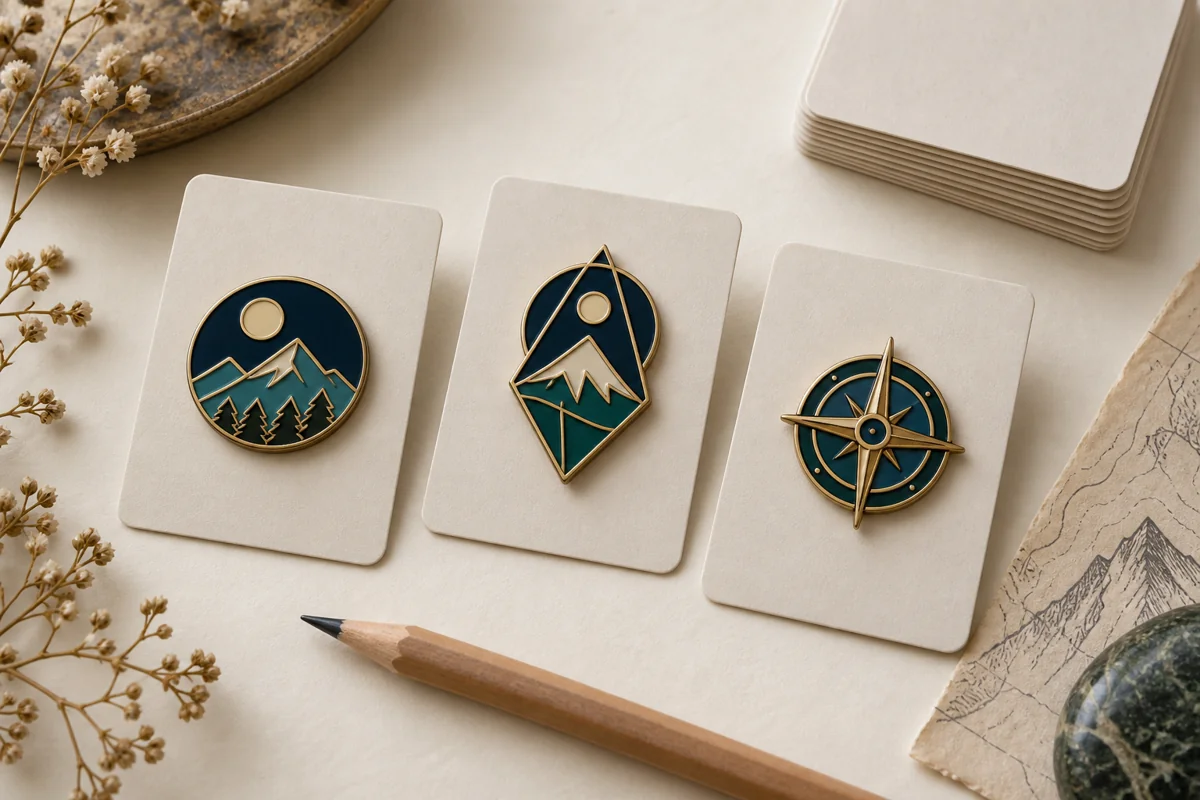
- Symbolisme: Utilisez des icônes et des images pertinentes qui racontent l'histoire de votre organisation
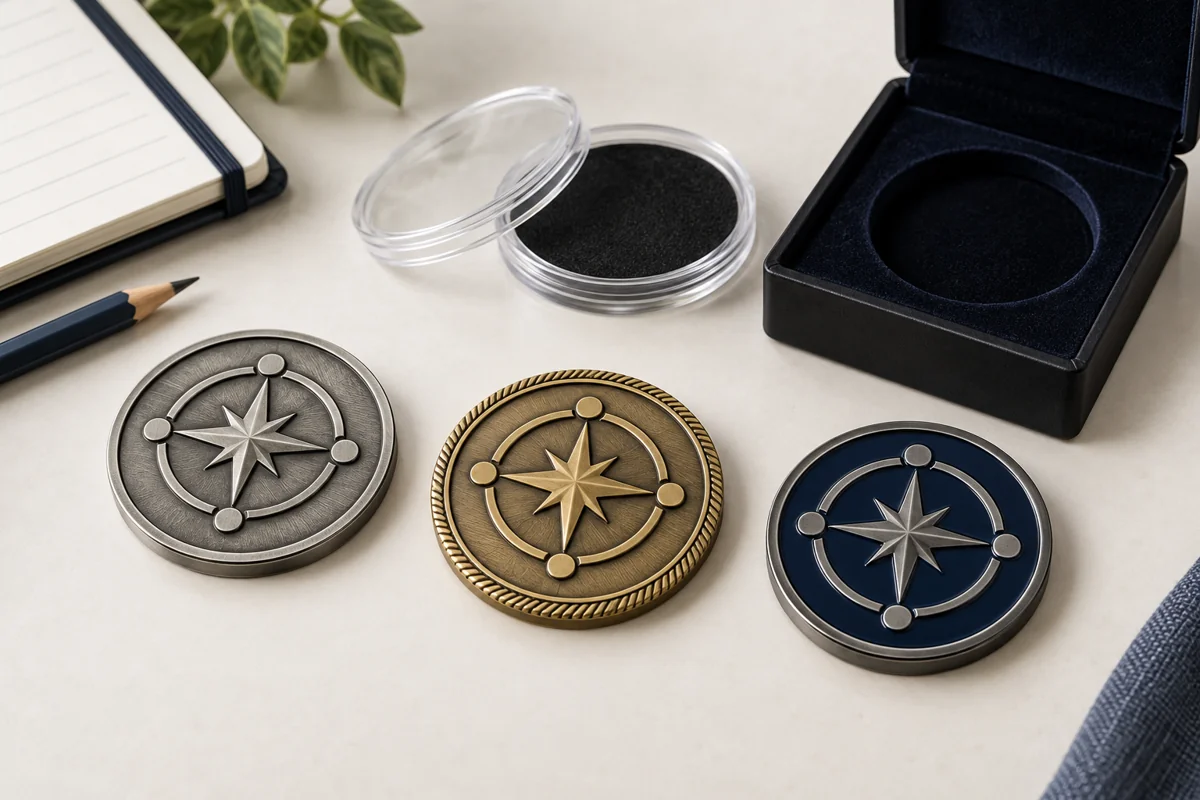
- Palette de couleurs: Optez pour des finitions métalliques en accord avec l'identité de la marque (or, argent, bronze, cuivre ou émaux personnalisés)
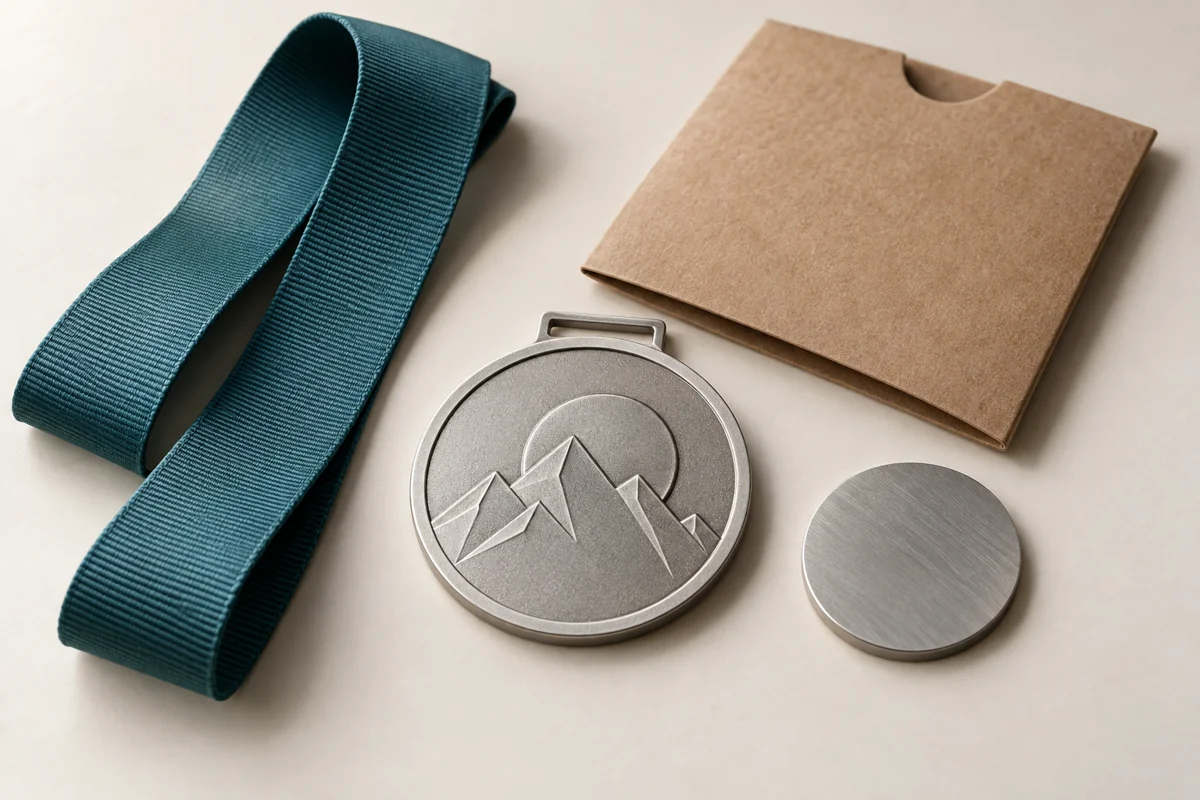
- Taille et forme: Les dimensions standard vont de 3,8 cm à 6,3 cm ; des formes personnalisées sont disponibles pour une image de marque unique
Considérations relatives aux matériaux
- Métaux communs: Alliage de zinc, laiton ou cuivre pour une meilleure durabilité
- Finitions: Finitions anciennes, polies, mates ou mixtes pour un effet visuel attrayant
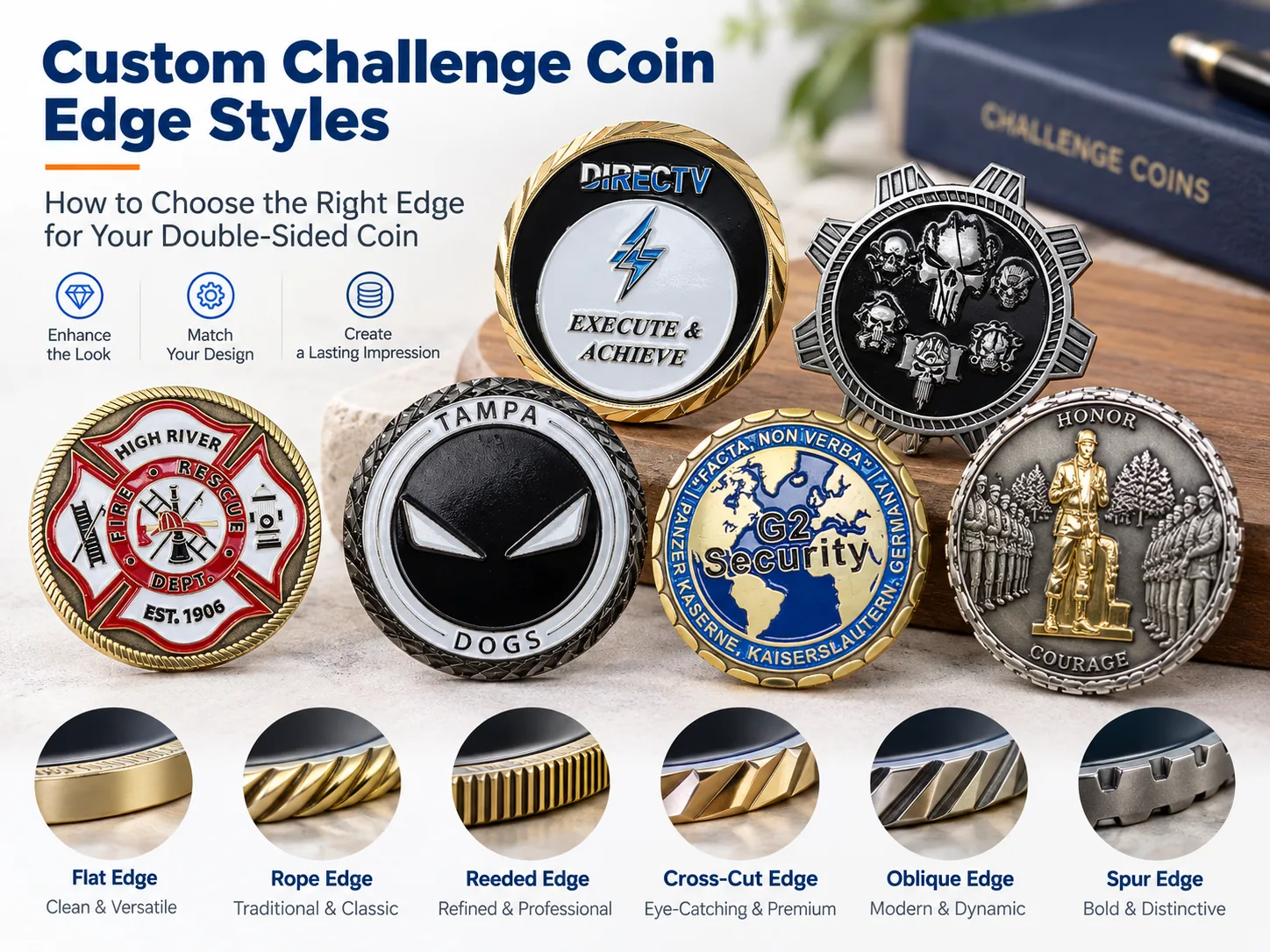
- Détails des bords: Bords cannelés, diamantés ou lisses pour une expérience tactile
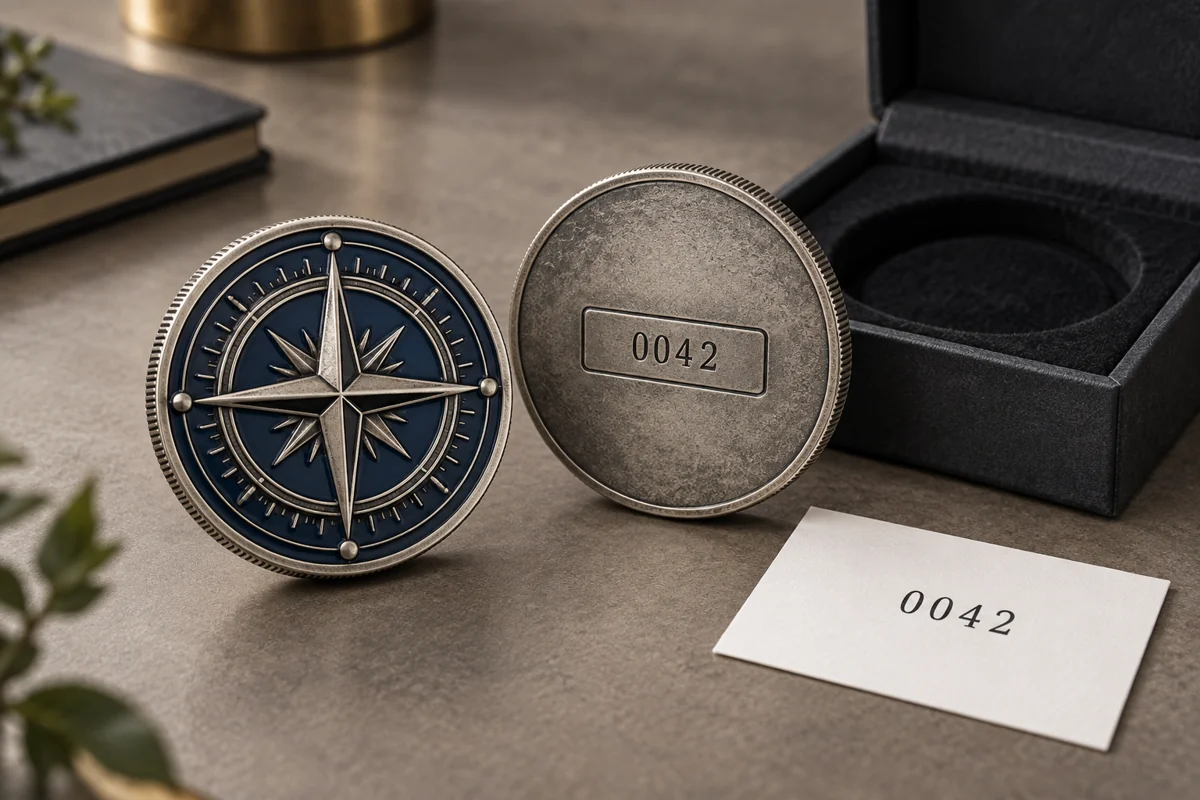
- Revêtements de protection: Revêtement époxy pour une durabilité accrue et un effet de profondeur
Ce qui fonctionne :
Une utilisation judicieuse des médailles personnalisées reflète les valeurs et la culture de l'organisation.
- Des designs simples et audacieux qui restent lisibles même en petits caractères
- Une utilisation équilibrée des espaces positifs et négatifs
- Un texte et des chiffres clairs et lisibles
- Un symbolisme fort qui trouve un écho chez les destinataires
- Une fabrication de qualité professionnelle conforme aux normes de l'organisation
À éviter :
- Encombrement dû à un trop grand nombre d'éléments ou de texte
- Des détails complexes qui perdent de leur netteté à petite échelle
- Des styles visuels incohérents qui vont à l'encontre de l'identité de marque
- Des modèles génériques pouvant s'appliquer à n'importe quelle organisation
- Une fabrication de mauvaise qualité qui nuit à la perception de la valeur
Pour mettre en place un programme de médailles commémoratives personnalisées, il faut d'abord bien comprendre la culture de votre organisation.
Audit culturel
Avant de lancer un programme de médailles commémoratives, évaluez vos systèmes de reconnaissance actuels et vos besoins culturels :
- Quelles sont les valeurs fondamentales de votre organisation ?
- Quels sont les accomplissements ou les comportements qui méritent une reconnaissance particulière ?
- Quel est votre budget pour les programmes de reconnaissance ?
- Comment les pièces seront-elles présentées et distribuées ?
- Quels indicateurs permettront de mesurer la réussite du programme ?
Adhésion des parties prenantes
Obtenir le soutien de la direction et celui des différents services :
- Présenter l'analyse de rentabilité avec les prévisions de retour sur investissement
- Partagez les exemples de réussite d'organisations similaires
- Démontrer la cohérence avec les stratégies existantes en matière de ressources humaines et d'entreprise
- Susciter l'enthousiasme grâce à des leaders engagés
Catégories de récompenses
Médailles pour les réalisations individuelles
- Étapes importantes en matière d'ancienneté
- Prix d'excellence
- Reconnaissance de l'innovation et de la créativité
- Réalisations en matière de développement du leadership
- L'excellence du service client
Pièces d'équipe
- Célébrations marquant l'achèvement du projet
- Récompenses pour les performances d'équipe
- Reconnaissance de la collaboration interfonctionnelle
- Étapes clés en matière de sécurité ou de qualité
- Les défis de l'équipe d'innovation
Médaille d'entreprise
- Objets commémoratifs pour les anniversaires d'entreprise
- Intégration post-fusion ou post-acquisition
Les médailles personnalisées sont idéales pour commémorer les anniversaires ou les réussites marquants d'une entreprise.
- Cérémonies de lancement de produit
- Réalisations dans le cadre des initiatives stratégiques
- Étapes clés de la transformation culturelle
Mécanismes de distribution
- Remises de prix officielles: Cérémonies de remise de prix, réunions d'équipe, événements d'entreprise
- Reconnaissance surprise: Remerciements spontanés pour un travail exceptionnel
- Programmes de partage entre particuliers: Les membres de l'équipe qui proposent la candidature de leurs collègues
- Programmes par étapes: Distribution automatique à l'occasion d'anniversaires de service ou lorsque certains objectifs sont atteints
Stratégie de communication
- Suscitez l'intérêt grâce à des campagnes de teasing
- Organisez des cérémonies de remise de prix qui soient significatives et exceptionnelles
- Partager les témoignages des bénéficiaires par le biais de la communication interne
- Définissez des critères et des attentes clairs pour gagner des pièces
- Proposer des solutions de présentation (cadres, supports, vitrines)
Formation des responsables
Donner aux responsables et aux superviseurs les moyens de :
- Présenter les pièces de monnaie de manière efficace en les replaçant dans un contexte pertinent
- Expliquez la signification et la symbolique
- Mettre en lien les réalisations individuelles avec les valeurs de l'organisation
- Créez des moments de présentation inoubliables
- Encourager la participation continue au programme
Indicateurs d'engagement des employés
- Indice de recommandation des employés (eNPS)
- Taux de participation aux programmes de reconnaissance
- Résultats de l'enquête de satisfaction des employés
- Données relatives à la fidélisation et au roulement du personnel
- Mobilité interne et taux de promotion
Mesures de l'impact culturel
- Évaluations de l'alignement des valeurs
Mesurer l'impact des médailles personnalisées peut en dire long sur la satisfaction et l'engagement des employés.
- Indicateurs de qualité de la collaboration au sein de l'équipe
- Efficacité de la communication interne
- Taux de recommandation par les employés
- Analyse des sentiments dans les médias sociaux
Corrélations entre les performances commerciales
- Indicateurs de productivité et de performance
- Indices de satisfaction client
- Indicateurs d'innovation (brevets, lancements de nouveaux produits)
- Performances en matière de qualité et de sécurité
- Chiffre d'affaires par employé
Une entreprise technologique de taille moyenne a mis en place un programme complet de « challenge coins » et a suivi les résultats sur une période de 18 mois :
- Engagement des employés: Passé de 67% à 82% (amélioration de 15 points)
- Fidélisation: Baisse du taux de départs volontaires, qui est passé de 181 à 91 (soit une diminution de 50)
- Reconnaissance et participation: Le nombre d'employés recevant ou accordant des marques de reconnaissance est passé de 45% à 89%
- Réduction des coûts: Réduction des coûts de recrutement et de formation d'environ 1 434 000 livres sterling par an
- Performances: Les équipes ayant mis en place des programmes de récompenses ont affiché une productivité supérieure de 23% à celle des groupes témoins
Une utilisation créative des médailles personnalisées peut renforcer leur attrait et leur importance auprès des employés.
Accueil des nouveaux employés
- L'entreprise remet une médaille aux nouveaux employés lors de la séance d'intégration
- Préparez des kits de bienvenue contenant de la monnaie et des documents d'information
- Utilisez des pièces de monnaie pour présenter l'histoire et les traditions de l'organisation
- Créer immédiatement un sentiment d'appartenance et d'identité
Intégration interdépartementale
- Créer des médailles pour récompenser les projets interfonctionnels couronnés de succès
- Utilisez des pièces de monnaie pour briser les cloisonnements et favoriser la collaboration
- Récompenser les employés qui se distinguent par leur esprit d'équipe au-delà des frontières
Anniversaires d'entreprise
- Pièces commémoratives en édition limitée pour les années marquantes
- Pièces commémoratives retraçant l'évolution de l'organisation
- Pièces commémoratives rendant hommage aux fondateurs et aux origines de l'entreprise
Lancements de produits
- Médaille de réussite pour les équipes de développement
- Médaille commémorative pour les résultats de vente à l'occasion du lancement
- Récompenses pour les premiers utilisateurs et les retours d'expérience
Initiatives stratégiques
- Médaille de reconnaissance pour la transformation numérique
- Médailles récompensant les réalisations en matière de développement durable
- Pièces commémoratives « Innovation Challenge » pour des solutions créatives
Remerciements à nos partenaires
L'utilisation judicieuse de médailles personnalisées permet d'améliorer considérablement la reconnaissance des partenaires.
- Créez des pièces communes pour des collaborations fructueuses
- Offrir des pièces de monnaie à l'occasion des anniversaires de partenariat
- Récompenser les fournisseurs qui dépassent les attentes
Réussite client
- Des médailles de réussite pour les clients, en hommage à nos succès communs
- Célébrations marquant les étapes importantes du partenariat
- Reconnaissance des recommandations et du plaidoyer
Tarification au volume
Le coût des médailles personnalisées varie en fonction des matériaux utilisés et de la complexité du design.
| Plage de quantités | Coût par pièce | Investissement total (100 pièces) |
|---|
| 50-100 | $8-15 | $800-1,500 |
| 101-500 | $5-10 | $500-5,000 |
| 501-1,000 | $4-7 | $2,000-7,000 |
| 1,000+ | $3-5 | $3,000+ |
Facteurs liés à la qualité et à la complexité
- Matériaux de base: Alliage de zinc ($2-4), laiton ($3-6), cuivre ($4-8)
- Options de finition: Finition standard incluse ; finitions haut de gamme (+$1-3)
- Émail coloré: Couleurs standard incluses ; couleurs personnalisées (+$0,50-2)
- Variations de taille: Taille standard (4,4 cm) incluse ; tailles personnalisées (+$1-3)
- Emballage: pochette de base incluse ; coffrets haut de gamme (+$1-5)
Phase de conception (2 à 4 semaines)
- Élaboration du concept initial
- Itérations de conception et validations
- Création et révision d'épreuves numériques
- Approbation définitive des plans
Phase de production (4 à 6 semaines)
- Conception d'outils pour la fabrication de matrices sur mesure
- Fabrication et validation d'échantillons
- Série complète
- Contrôle qualité et inspection
La phase de livraison des médailles personnalisées est essentielle pour garantir une distribution dans les délais.
Phase de livraison (1 à 2 semaines)
- Expédition et logistique
- Gestion des stocks
- Planification de la distribution
Critères d'évaluation des fournisseurs
- Expérience et réputation dans le secteur
- Portfolio de réalisations similaires pour des entreprises
- Capacité de production et délais d'exécution
- Processus d'assurance qualité
- Transparence des prix et proposition de valeur
- Service client et communication
Liste de contrôle pour l'assurance qualité
- Composition et durabilité des métaux
- Cohérence des détails des bords
- Qualité et uniformité de la finition
- Précision des couleurs et application de l'émail
- Poids et centrage
- Qualité de l'emballage et de la présentation
Exigences en matière d'autorisation
- Recherches de marques pour tous les logos et éléments de marque
Il est indispensable de bien comprendre les exigences en matière d'autorisation pour les médailles personnalisées afin d'éviter tout problème juridique.
- Autorisation relative aux logos ou images de tiers
- Respect des règlements de la branche militaire (le cas échéant)
- Autorisation relative aux droits d'auteur pour toute illustration ou tout dessin
Consignes d'utilisation
- Établir des règles claires concernant la présentation et l'utilisation des pièces
- Définir les contextes appropriés pour la présentation
- Élaborer des directives relatives à la reproduction ou à la photographie
- Définir des politiques relatives au partage sur les réseaux sociaux
Considérations relatives à l'accessibilité
- Éléments tactiles destinés aux destinataires malvoyants
- Des éléments visuels clairs et très contrastés
- Options de texte en braille ou tactile
- Une taille et un poids adaptés à différents types d'utilisateurs
Sensibilité culturelle
- Évitez les symboles ou les images ayant des connotations culturelles négatives
- Prendre en compte les différentes interprétations des éléments de conception
- Veiller à la diversité dans les représentations visuelles
- Veillez à ce que les choix linguistiques soient inclusifs
Les tendances futures laissent entrevoir une demande croissante de médailles personnalisées dans le cadre des programmes de reconnaissance en entreprise.
Programmes hybrides (en ligne et en présentiel)
- Codes QR renvoyant vers des profils de reconnaissance numériques
- La technologie NFC pour des expériences interactives
- Fonctionnalités de réalité augmentée pour une narration enrichie
- Vérification via la blockchain de l'authenticité et de la provenance
Technologies Smart Coin
- Puces intégrées pour le suivi et la vérification
- Finitions thermosensibles
- Matériaux photosensibles
- Possibilités d'intégration biométrique
Des designs innovants pour les médailles personnalisées sont essentiels pour attirer l'attention et susciter l'admiration.
Matériaux durables
- Teneur en métal recyclé
- Options d'emballage écologiques
- Procédés de production neutres en carbone
- Matériaux recyclés issus d'équipements hors service
Fabrication de pointe
- L'impression 3D pour les géométries complexes
- Gravure au laser pour les détails fins
- Éléments de techniques mixtes (bois, pierres précieuses, autres matériaux)
- Personnalisation des données variables à grande échelle
L'intégration de la technologie dans les médailles personnalisées peut améliorer leur fonctionnalité et leur attrait.
Comprendre la valeur stratégique des médailles personnalisées peut transformer la culture d'entreprise.
À une époque où la reconnaissance numérique et les récompenses virtuelles dominent le monde du travail, les « challenge coins » offrent quelque chose de rare et de précieux : des symboles tangibles et durables de réussite qui créent des liens émotionnels durables et renforcent la culture d'entreprise.
Les organisations qui mettent en place avec succès des programmes de « challenge coins » constatent que les avantages vont bien au-delà de l'investissement initial : un engagement accru des employés, une cohésion d'équipe renforcée, une meilleure harmonisation des cultures d'entreprise et une amélioration mesurable des performances commerciales.
En concevant avec soin et en mettant en œuvre de manière stratégique des programmes de « challenge coins », les dirigeants visionnaires peuvent créer des expériences de reconnaissance que les employés apprécient sincèrement, partagent et gardent en mémoire, transformant ainsi le concept abstrait de culture d'entreprise en quelque chose de concret, de significatif et de profondément personnel.
Les médailles personnalisées peuvent créer des liens forts entre les employés et favoriser leur fidélité.
La tradition des « challenge coins », née dans les tranchées militaires, s'est transformée en un outil commercial puissant pour les organisations modernes qui cherchent à instaurer une culture de la reconnaissance, de la réussite et de l'appartenance. Dans un monde où les remerciements numériques sont éphémères et les certificats souvent génériques, le poids, la durabilité et la valeur symbolique d'un « challenge coin » bien conçu continuent de créer des moments qui comptent.
Êtes-vous prêt à transformer la culture de la reconnaissance au sein de votre organisation grâce au pouvoir des « challenge coins » ?
Grâce aux médailles personnalisées, les entreprises peuvent instaurer une culture de la reconnaissance à laquelle les employés accordent de l'importance.
Épingles associées Ressources PinsCraftPro
Si vous êtes à la recherche de produits métalliques sur mesure pour une prochaine campagne, ces guides et pages produits vous aideront à choisir le style, la finition et le mode de commande qui vous conviennent.
Découvrez les avantages d'intégrer des médailles personnalisées à vos stratégies de reconnaissance des employés.
Les médailles personnalisées constituent un moyen efficace de renforcer la reconnaissance et la satisfaction des employés.
Pour en savoir plus, consultez nos ressources sur les médailles commémoratives personnalisées et leur impact.