





Two suppliers quote the same quantity of coins. One shows a lower unit price; the other includes the mold, individual capsules and delivery. Which is cheaper? Until the missing items are reconciled, neither number answers the question.
To compare custom challenge coin cost, use a complete specification and a delivered-cost worksheet. This guide explains how to build one, which design decisions affect the quote, and how to separate production time from the date your team can actually use the coins.
What the latest industry numbers do—and do not—tell buyers
On September 8, 2026, PPAI reported an Oxford Economics study estimating that branded merchandise supported $472.3 billion in global GDP in 2025. The study examines a broad economic footprint, including indirect and induced effects. That figure is not challenge coin sales, a coin-price index or a forecast for your project.
For an individual buyer, the relevant takeaway is the number of activities behind a delivered product: materials, customization, packing and distribution. A headline unit price may include only some of them. The worksheet below is our purchasing framework, not a calculation supplied by that study.
Freeze the specification before comparing prices
Ask every supplier to quote the same dimensions, thickness, base material, artwork on each side, finish, color method, edge, quantity and packaging. Include the delivery location and target arrival date. If a supplier recommends a different construction, keep it as a clearly labeled alternative.
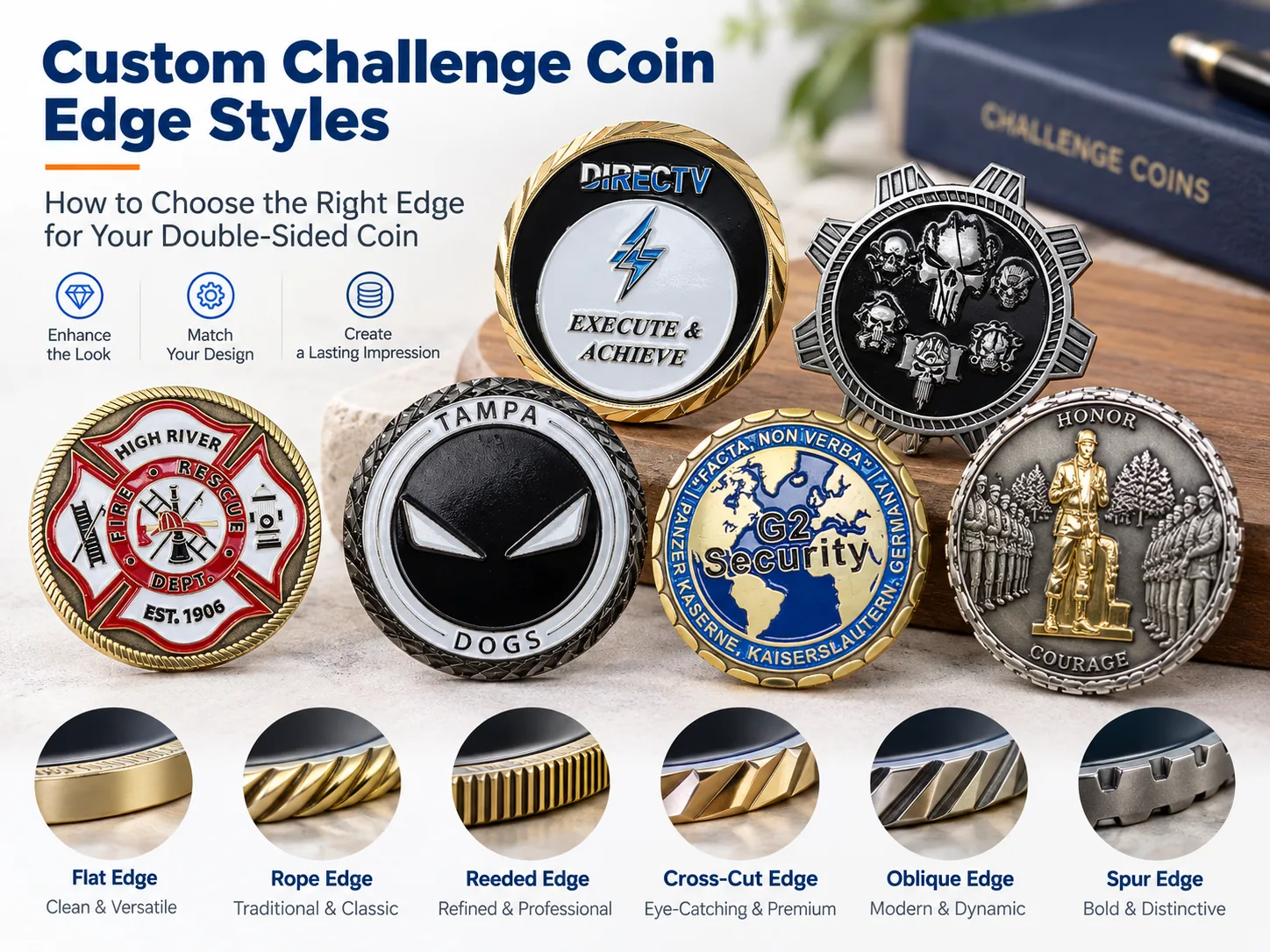
A 2D design and a sculpted 3D design are not the same specification even when both feature the same logo. Likewise, a plain edge and a decorative cut edge, or a simple pouch and a fitted presentation box, should not be hidden inside one undifferentiated “coin price.”
Review custom challenge coin options and the coin edge comparison while choosing the specification. Obtain confirmation of feasibility rather than treating a website concept image as a production drawing.
Separate fixed, per-piece and delivery costs
| Cost group | Possible items | Clarifying question |
|---|---|---|
| Fixed setup | Tooling, sculpting, sampling or initial artwork work | Which items recur on an unchanged reorder? |
| Per coin | Body, finish, color decoration and edge work | Does the price cover the approved specification on both sides? |
| Personalization | Names, numbering or variable artwork | Are data setup and checking included? |
| Packaging | Capsules, boxes, cards and assembly | Is each coin packed or are components supplied separately? |
| Delivery | Freight, insurance and destination handling | Which charges are prepaid and which remain the buyer’s responsibility? |
Not every order carries every charge. The purpose of the list is to expose assumptions, including items advertised as included. Ask for quote validity, payment currency and the treatment of any destination taxes or duties. Your broker or responsible import adviser should confirm charges for the actual shipment; do not infer a rate from a general blog article.
Work through a comparison with the same denominator
The following figures are invented examples in USD, not current market rates or PinsCraftPro quotations. Both hypothetical offers cover 300 identical accepted coins and the same delivery scope, with no additional charges beyond those listed.
- Quote A: 300 × $3.80 production + $140 setup + $120 packaging + $190 freight = $1,590.
- Quote B: 300 × $4.20 production + $0 separately billed setup + $60 packaging + $150 freight = $1,470.
Under those assumptions, Quote B is $120 lower despite its higher production unit price. The comparable delivered cost is $5.30 per coin for A and $4.90 for B. If one quote excludes a required charge, label its total incomplete instead of treating the unknown value as zero.
Use the number of usable, accepted pieces needed for the program as the comparison basis. A larger quoted quantity may lower a unit price while raising cash outlay. Extra coins have value only if you have a credible use for them.
Identify which design change would actually save money
Ask for priced alternatives rather than requesting that the supplier “make it cheaper.” Good alternatives preserve the essential purpose while changing a specific feature: a less complex edge, a simpler reverse, a different package, or fewer distinct artwork variants.
Do not assume that every simplified feature produces a proportional reduction. Tooling, assembly and process constraints vary. Request the revised price and a description of exactly what changes. If you remove a box from a ceremonial coin, for example, you may reduce cost but undermine the presentation that justified the purchase.
Size and thickness affect the physical specification and may affect shipping weight. However, no universal percentage saving can be calculated without the actual design and quote. Approve the resulting sample so a cost reduction does not create an unexpected feel or loss of readable detail.
Compare reorders separately from the first purchase
A first order may include development costs that do not recur in the same way. Ask who retains the tooling, for how long, what changes require new tooling and whether an unchanged reorder can use the same production files. Keep those answers with the approved proof.
“Same coin again” can conceal changes in a date, department name or serial range. Send the original order reference and a marked list of revisions. Do not assume that a previous unit price remains valid indefinitely or that a new batch will arrive by the old lead time.
If repeat orders are likely, request an indicative reorder scenario alongside the initial quote. Treat it as planning information subject to the supplier’s stated validity, not a guaranteed future price.
Put arrival, dispatch and production completion on separate lines
A production promise of a certain number of days does not by itself establish an arrival date. Clarify when the production clock starts: after artwork approval, sample approval, payment or another stated condition. Then allow for inspection, packing, dispatch, transit and destination processing.
Ask whether the quoted days are working days or calendar days, and what happens when an approval is delayed. Your internal review time belongs on the schedule too. A committee that takes a week to approve a proof cannot treat that week as manufacturing time.
For a fixed ceremony, explain the latest acceptable arrival date and request written confirmation of the route and contingency. A partial expedited shipment may be worth discussing, but its feasibility and extra cost must be confirmed before relying on it.
Clarify acceptance and remedies before paying
Attach the approved proof or sample reference to the purchase order. Record the finish, artwork orientation, packaging, personalization file and quantities. Agree on the receiving inspection window and how the supplier wants issues documented.
Ask how shortages, incorrect personalization or unacceptable damage will be handled, including the timing of any replacement relative to your event. A remedy delivered after the presentation date may not solve the operational problem, even if it resolves the financial one.
For recognition projects, our employee recognition coin planning guide helps connect the product specification with the ceremony and recipient experience.
Use a short decision record instead of choosing the lowest line
Make a one-page comparison showing specification match, complete delivered cost, approval requirements, arrival assumptions, sample confidence and remedies. Mark unresolved points as unresolved. Do not award a supplier a better score because their quote says less.
The final question is whether the offer delivers the intended product, in the required quantity and condition, by the date that matters. Price is essential, but an incomplete quote is not yet a price you can compare.
Send PinsCraftPro your artwork and purchasing brief with dimensions, quantity, destination, packaging and required arrival date. Request one preferred specification and one clearly defined cost-saving alternative. A complete brief makes it easier to explain the difference between two quotations—and to choose with confidence.