




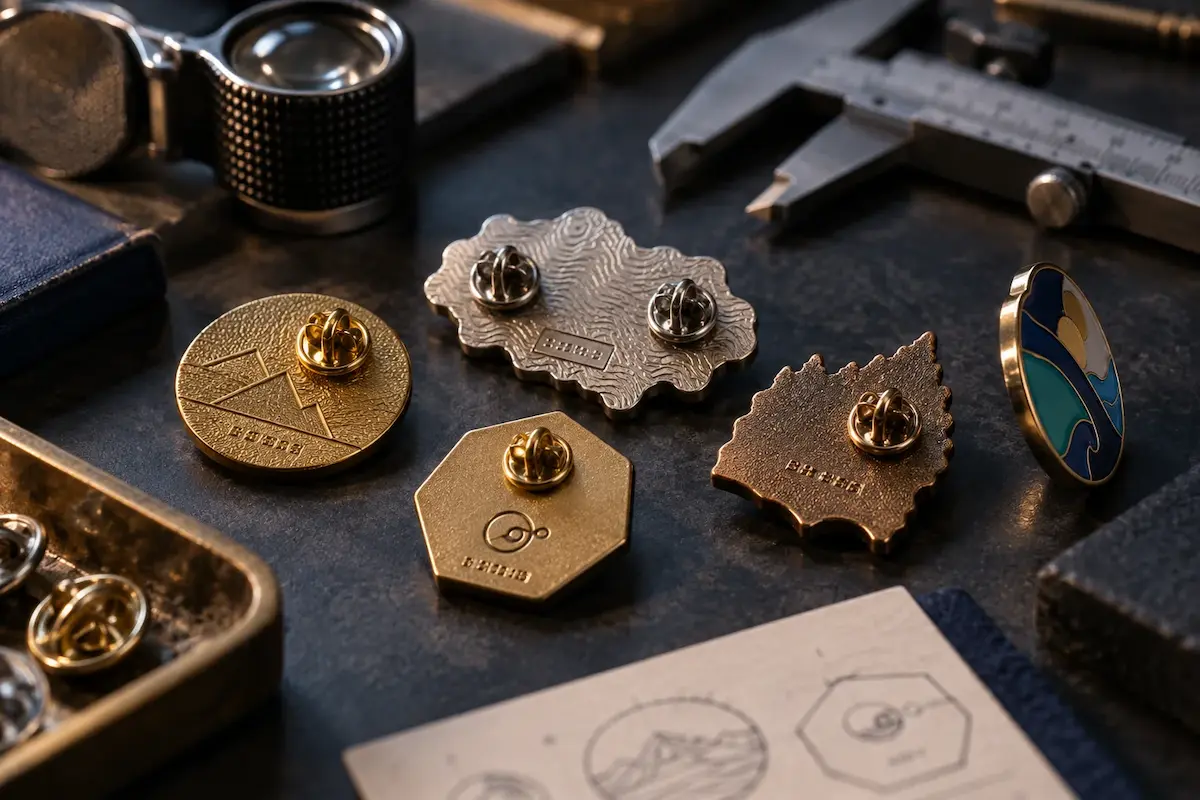
A custom pin reorder looks simple: send the previous artwork, confirm the quantity, and ask the factory to make the same product again. In practice, a reorder is a controlled replication project. Color batches change, plating chemistry drifts, packaging components go out of stock, and an undocumented “small improvement” can create a visibly different version.
For brands, clubs, retailers, and promotional product distributors, consistency protects customer expectations and reduces mixed inventory. This guide shows how to build a reorder file, preserve a meaningful reference sample, manage changes, and inspect the new batch without demanding impossible zero-variation manufacturing.
Why Custom Pin Reorders Can Look Different
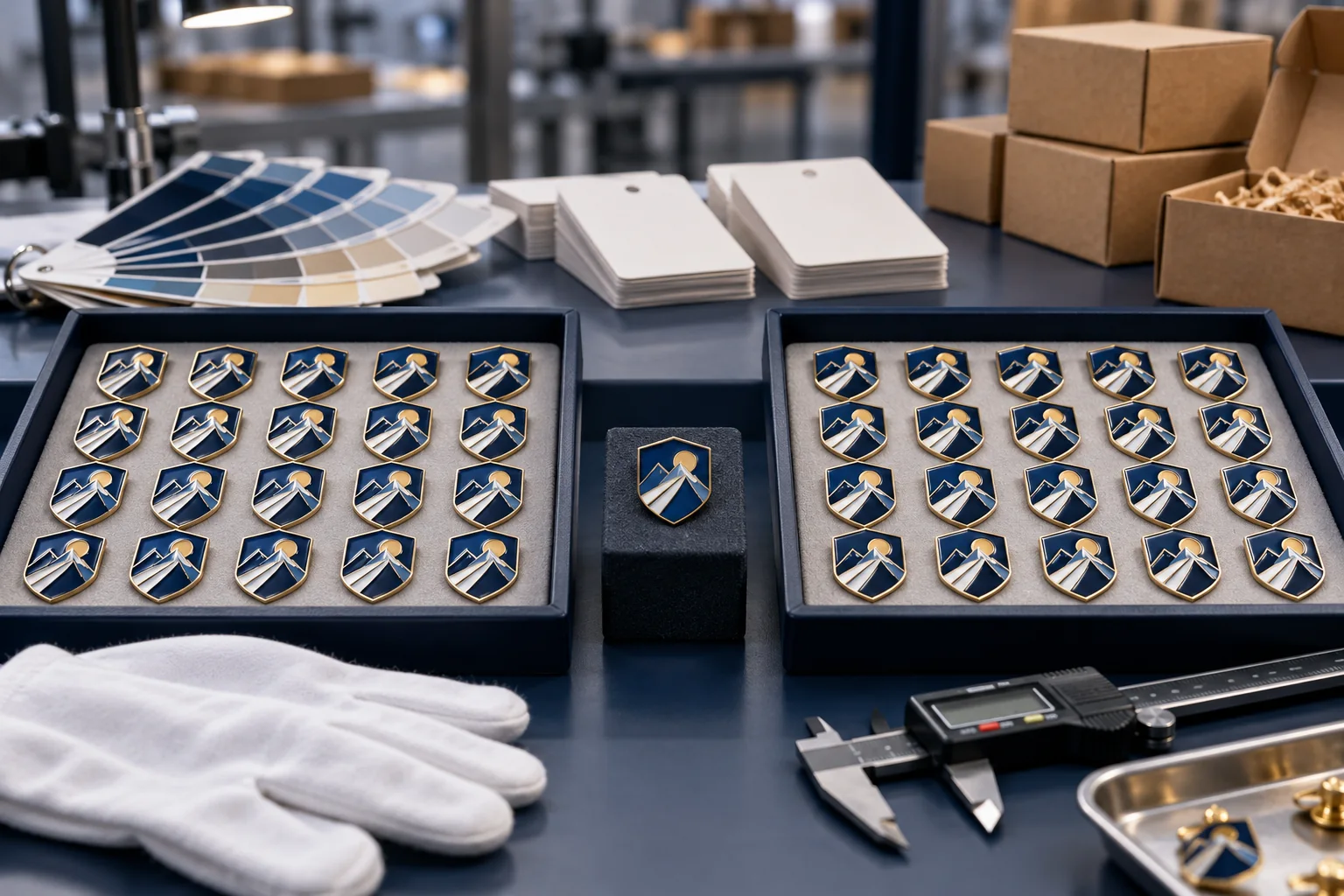
Enamel pins are manufactured through several linked processes: tooling, metal forming or casting, polishing, plating, enamel filling, curing, attachment, inspection, and packing. Each step introduces a small amount of normal variation. When several uncontrolled differences accumulate, the second run may no longer match the first closely enough to sell as one SKU.
Common causes include:
- a new color batch mixed from a visual screenshot rather than a recorded standard;
- different base metal, thickness, or polishing time;
- replacement tooling made from an exported preview instead of the approved vector file;
- a change from one plating line or subcontractor to another;
- substitute clutches, backing cards, bags, or cartons;
- an unrecorded artwork correction treated as an exact reorder;
- production at a different factory using its own construction standards.
The practical goal is controlled consistency, not a claim that every piece will be molecularly identical. A capable pins personalizados program defines which characteristics are critical, what variation is acceptable, and who approves a change.
Build a Reorder Master File
The reorder master file is the single source of truth for the SKU. It should survive staff changes, agency handoffs, and long gaps between production runs. A thumbnail in an email thread is not enough.
At minimum, archive:
- the final vector artwork and the approved production proof;
- finished width, height, and metal thickness;
- base metal or casting material;
- enamel type and recorded color references;
- plating color, sheen, and any antique treatment;
- post count, exact post placement, and clutch type;
- backstamp construction and serial-number rules;
- packaging materials, card stock, print file, bag, and carton pack-out;
- tooling number, supplier order number, and approval date;
- photos of the approved sample under neutral lighting.
Use a structured custom pin specification sheet rather than relying on memory. The file should identify the approved revision so that an old proof cannot be mistaken for the current version.
Keep a Golden Sample—and Define What It Means
A golden sample is a retained physical unit that represents the approved product. It gives the factory and buyer something real to compare with a new batch. The term is useful only when the sample is controlled.
Label the sample with the SKU, revision, order number, production date, and approval status. Store it away from direct sunlight, humidity, abrasion, and reactive packaging. Enamel color can appear different under warm office light, daylight, and cool inspection lamps, so comparisons should be made under consistent illumination.
For high-volume or multi-location programs, retain at least two approved units: one with the buyer and one with the manufacturer. If the visual standard is especially important, agree that neither party may replace its reference without written approval.
A golden sample is evidence, not the entire specification. It must be used with measured dimensions, recorded colors, approved files, and written tolerances.
Control Enamel Color Across Batches
Color is the most common source of reorder disputes because people evaluate it quickly and subjectively. Screenshots, RGB values, and photographs are poor production masters: displays differ, image compression changes color, and camera white balance can shift the result.
Record a recognized physical color reference where possible and keep the exact code in the purchase specification. The article on Pantone color matching for custom enamel pins explains why the reference is a target rather than a guarantee of perfect optical identity. Enamel chemistry, curing temperature, surrounding metal, surface gloss, and lighting all affect perception.
For a reorder, ask the supplier to compare fresh color fills with both the recorded standard and the retained pin. If a brand color is critical, approve a pre-production sample or color drawdown before the full run. Also state whether the new batch will be mixed with remaining old inventory; a difference acceptable in separate sales periods may be obvious when the two runs sit on the same display card.
Preserve Tooling and Mold Information
Reusing approved tooling can improve geometric consistency and reduce setup cost, but buyers should not assume every mold is stored indefinitely. Tooling may wear, corrode, be archived off-site, or be discarded after a stated retention period. A factory may also need to remake a die after a large cumulative quantity.
Before placing the reorder, confirm:
- whether the original tooling is still available and serviceable;
- the tooling or mold reference number;
- whether storage or reuse charges apply;
- whether any part of the die must be repaired or remade;
- who owns the tooling and whether it can be transferred;
- whether a backstamp or date change requires new tooling.
If new tooling is necessary, treat the order as a validation event. Require a new proof and sample comparison rather than assuming the archived artwork will reproduce the old geometry automatically.
Match Metal, Plating, and Surface Finish
“Gold” and “silver” are broad descriptions, not complete plating specifications. Bright gold, pale gold, antique gold, satin gold, and imitation gold can look quite different. Even a nominally identical bright nickel finish may vary with polishing, bath condition, rack position, and the underlying metal surface.
Record the finish in precise terms and use photographs only as supporting evidence. If the original order used a nonstandard plating sample, keep that sample with the master file. For products sold as matched sets, specify that all pieces should be plated in the same production lot when feasible.
Metal thickness also affects weight, perceived quality, edge appearance, and post stability. Do not let a reorder default to the supplier’s current standard. The enamel pin thickness guide outlines how thickness interacts with size and construction.
Verify Dimensions, Posts, and Backings
Finished dimensions should be checked from the approved specification, not estimated from a product photo. Include overall width and height, thickness, cutout size, and any critical internal dimension. For paired pins or pins that fit a presentation insert, dimensional relationships may matter more than a single outside measurement.
Post placement is another frequent hidden difference. Moving a post a few millimeters can change how the pin hangs on fabric or whether it aligns with a backing-card hole. Record post centers relative to a stable datum on the artwork. For a two-post pin, specify the orientation so the product cannot be packed upside down.
Backings should be defined by material, color, shape, and performance—not merely “rubber clutch” or “metal clutch.” If the exact component is no longer available, request a substitute sample and approve it as a change.
Treat Packaging as Part of the Product
A visually consistent pin can still create a failed reorder if the card is a different white, the hole position changes, or the retail barcode is missing. Packaging often has more suppliers and more opportunities for substitutions than the pin itself.
Archive editable packaging files, outlined fonts, card dimensions, paper specification, coating, print color references, hole and slit positions, bag dimensions, warning labels, barcode data, and carton quantity. The custom pin packaging strategy guide can help buyers separate protective, retail, gift, and shipping requirements.
Ask the manufacturer to flag obsolete materials before production. A “closest available” backing card may be commercially acceptable, but it should be a buyer decision rather than an invisible factory substitution.
Separate an Exact Reorder from a Revision
Use explicit change categories to prevent confusion:
| Order type | Definition | Approval level |
|---|---|---|
| Exact reorder | Same approved files, dimensions, materials, finish, attachments, and packaging | Golden-sample comparison plus standard production approval |
| Controlled revision | One or more documented changes while the core product identity remains | New revision number, updated proof, and targeted sample approval |
| New SKU | A change that affects customer expectation, fit, collection identity, or inventory separation | Full new-product approval and separate stock record |
Changing a year, sponsor, clasp, pin size, or plating may look minor in an email. It can affect tooling, cost, lead time, compliance labeling, or compatibility with existing inventory. A short change log—what changed, why, who approved it, and when—prevents the next reorder from reverting to an obsolete version.
Use a Reorder Approval Workflow
A proportionate workflow balances speed and risk. A routine reorder from existing tooling may not need the same development cycle as a new design, but it still deserves objective checks.
- Issue the current master file. Send one controlled package rather than scattered attachments.
- Request a supplier confirmation. The manufacturer identifies unavailable tooling, materials, or components before quoting.
- Approve a refreshed proof. Confirm the revision, quantity, color references, plating, posts, backstamp, and packaging.
- Set the sample level. Choose a digital proof, production photo, or physical sample based on value and change risk.
- Authorize mass production in writing. Record the exact approved reference and date.
- Perform final inspection. Compare shipment samples with the golden sample and agreed tolerances.
El Lista de comprobación de la prueba de impresión catches visual and specification errors before approval, while a custom pin quality-control checklist supports in-process and receiving inspection.
Set Practical Acceptance Criteria
“Must match perfectly” is not measurable. Define the characteristics that would cause a customer complaint or operational failure. These may include incorrect artwork, wrong color family, missing enamel, exposed base metal, plating contamination, sharp edges, loose posts, nonfunctioning clutches, unreadable backstamps, incorrect card orientation, or mixed barcodes.
For dimensions and appearance, agree on tolerances appropriate to the process and design. Use an approved inspection sample size and document how defects are classified. A minor cosmetic observation on the back may not carry the same severity as a detached post or wrong front color.
When the second batch will be mixed with the first, inspect the two together under consistent light. Side-by-side comparison is stricter—and more commercially relevant—than judging the new batch alone.
Plan Reorder Timing Before Stock Runs Out
A reorder lead time includes more than factory production. It may involve tooling retrieval, proof reconfirmation, sample approval, raw-material scheduling, packaging printing, inspection, and international transit. Seasonal demand and major events can extend capacity queues.
Set a reorder point from average demand, desired safety stock, approval time, production time, and shipping time. If the program uses several related designs, consider whether combining them into one production window improves color and plating consistency. For a low-volume test or a design with uncertain demand, review the tradeoffs in small-batch and no-minimum custom pins before committing to a large repeat run.
Reorder RFQ Checklist
- SKU, revision number, and previous purchase-order reference
- Required quantity and acceptable overrun or underrun
- Original tooling number and confirmation of availability
- Approved vector proof and specification sheet
- Golden-sample location and comparison requirement
- Color references and policy for batch-to-batch variation
- Base metal, thickness, plating, and finish
- Post coordinates, clutch type, and backstamp
- Packaging files, materials, barcodes, and carton pack-out
- List of approved changes—or a statement that no changes are permitted
- Sample, inspection, delivery, and defect-remedy requirements
Preguntas frecuentes
Will a reorder always use the original mold?
No. Tooling may be unavailable, worn, or unsuitable after an artwork change. Confirm its status before ordering and require a new sample when a die is remade.
Can a manufacturer guarantee an exact color match?
Manufacturers can work toward an approved reference within an agreed tolerance, but enamel and plating have normal batch variation. A retained sample, physical color standard, consistent lighting, and pre-production approval reduce risk.
Do I need a physical sample for every reorder?
Not necessarily. An unchanged, low-risk repeat from serviceable tooling may be approved from the current file and production photos. A sample is more valuable when tooling, color, plating, size, components, supplier, or packaging has changed.
What if the original supplier is no longer available?
Treat the project as a new production transfer. Provide the master file and an approved sample, disclose critical characteristics, and validate new tooling. A new factory cannot reliably reconstruct hidden specifications from front artwork alone.
Conclusión final
Consistent custom pin reorders come from controlled information, not repeated promises to “make it the same.” Preserve the approved file, physical sample, tooling record, colors, hardware, and packaging details. Then classify changes, reapprove what matters, and inspect against measurable criteria. That discipline turns a one-time pin order into a scalable merchandise program.