





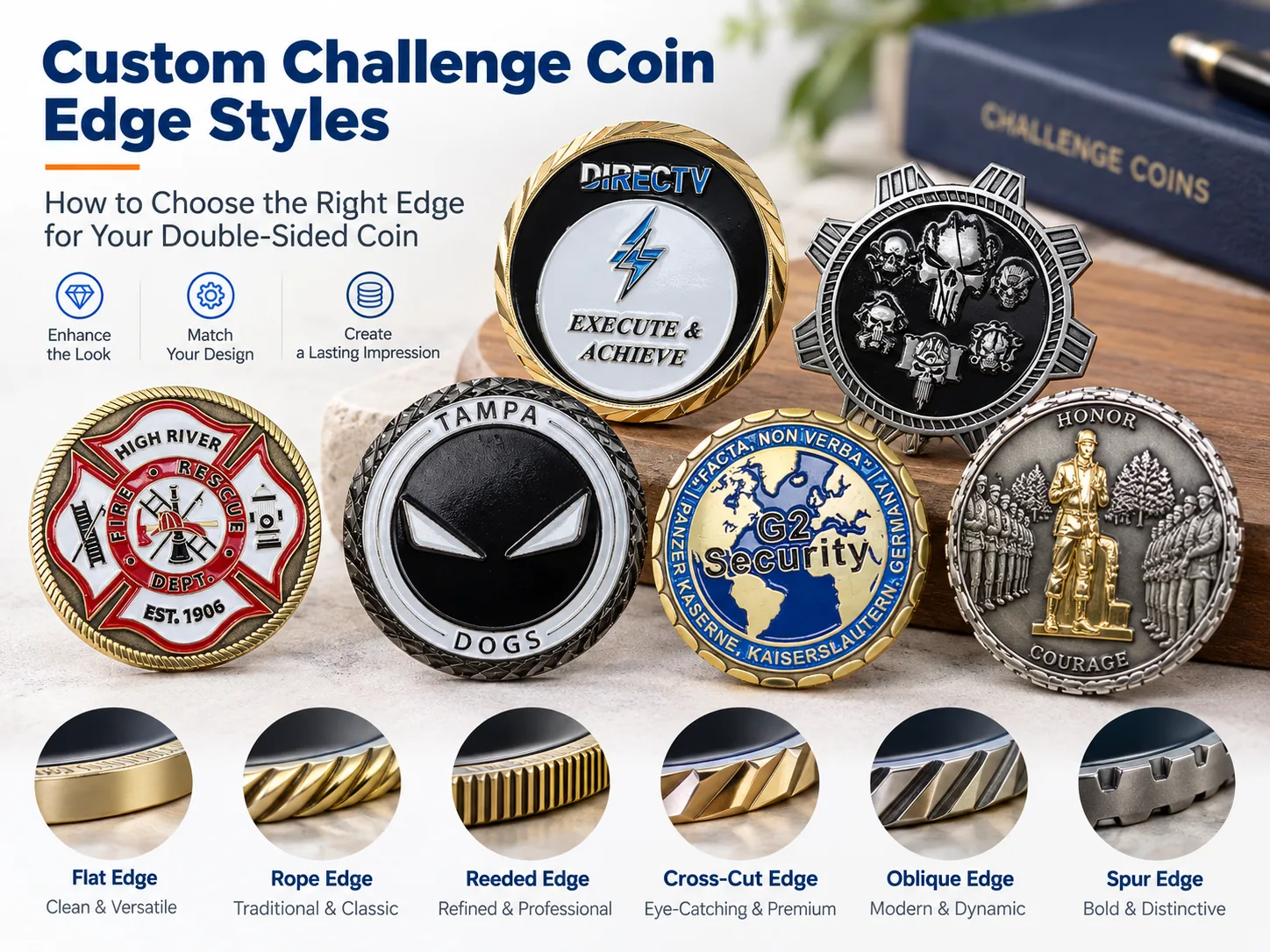
The edge of a challenge coin occupies very little visual space, yet it changes how the coin catches light, feels in the hand and frames the artwork. It is also easy to choose too late. Once the front and back are crowded with outer-ring text, a highly decorative edge can compete with information that was supposed to be prominent.
This guide compares common challenge coin edge options and gives you a practical way to shortlist them. The goal is not to find the most elaborate edge. It is to choose one that supports the message of the coin, works with the plating and remains compatible with the approved artwork.
Quick answer: use a standard or bezel-style edge when the artwork already carries the visual interest. Consider rope for nautical or ceremonial themes, oblique lines for controlled movement, leaf patterns for formal recognition, spur patterns for a sharper repeated texture, and sunburst patterns when the perimeter should feel energetic and radiant. Always compare the options at the same coin size and in the same plating.
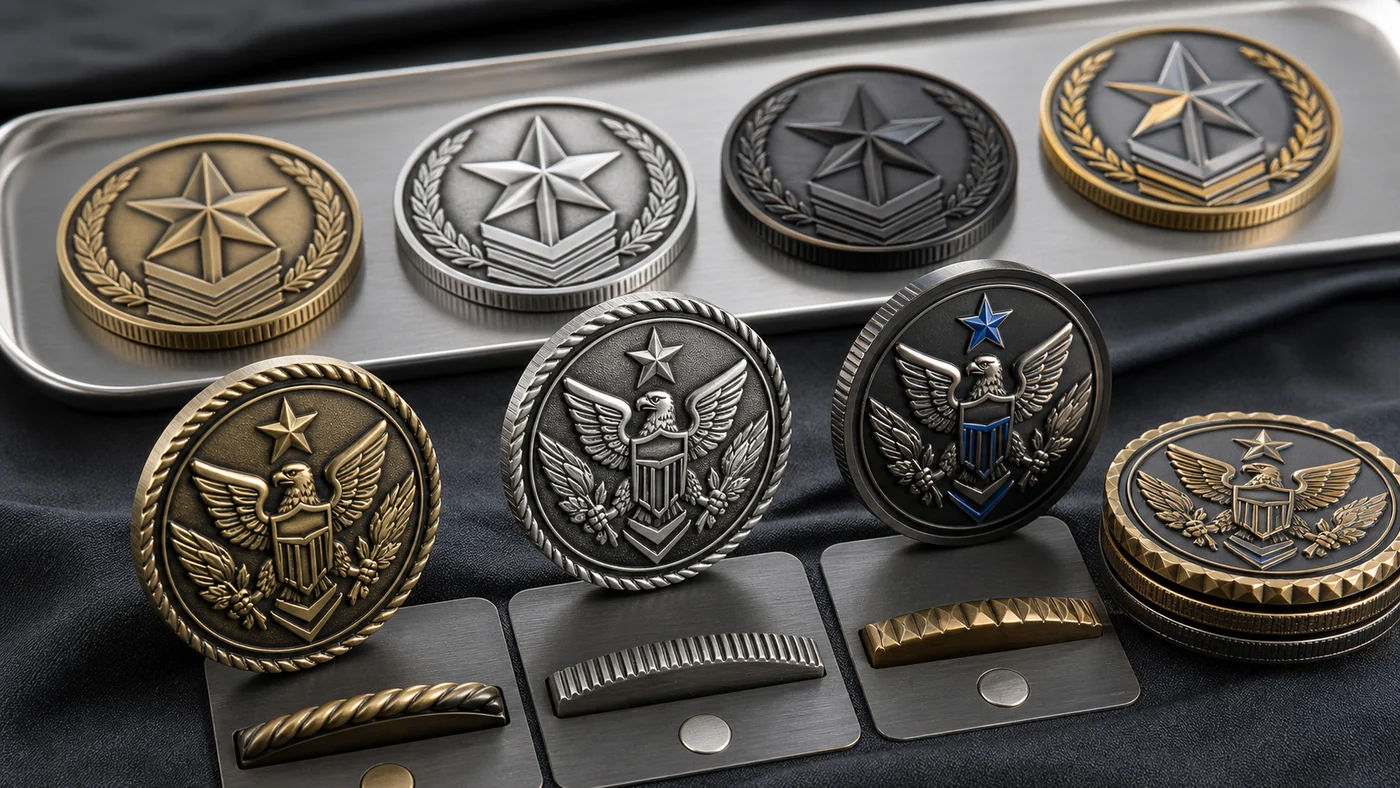
Challenge coin edge versus border: they are not the same
The edge is the narrow perimeter or side wall you feel when you hold the coin between your fingers. The border or rim is the visible band around the artwork on the front or back face. Search terms often mix the two, but a production proof should not.
This distinction matters because a decorative edge can affect the side profile while the front rim still carries a unit name, dates, a motto or a repeating pattern. If you ask to “change the border” when you mean the edge, the wrong part of the artwork may be revised. Label both on the proof.
Challenge coin edge options compared
Names can vary between manufacturers, and the same pattern can look different after changes in diameter, thickness, relief and plating. Use the descriptions below to build a shortlist, then confirm the exact pattern in an artwork proof or physical sample.
| Edge option | Visual character | Often works with | Review before approval |
|---|---|---|---|
| Standard | Clean, uninterrupted perimeter | Detailed faces, modern branding and restrained formal coins | Whether a plain edge gives the artwork enough finish and separation |
| Bezel | Simple sloped or faceted transition around the perimeter | Minimal artwork, corporate recognition and clean geometric layouts | How much light the angle catches in the selected plating |
| Cross-cut | Repeated facets that create a more reflective side profile | Commemorative designs that need texture without a literal motif | The exact cut pattern and whether it competes with a busy front rim |
| Rope | Twisted cord-like rhythm | Maritime, ceremonial, service and heritage-oriented designs | Whether outer-ring text remains visually separate from the rope pattern |
| Oblique line | Repeated diagonal cuts that suggest movement | Technical, athletic, automotive and contemporary themes | Direction, spacing and contrast under the chosen finish |
| Leaf | Decorative repeating leaf motif | Awards, honor, achievement and formal commemorations | Whether the motif supports the tone or makes the composition too ornate |
| Chain | Linked repeating pattern | Unity, strength, teamwork and industrial themes | Link scale and whether the pattern is legible at the selected diameter |
| Bike chain | More mechanical linked rhythm | Cycling, motorsport, engineering and maker communities | Whether the pattern reads as intended rather than as general texture |
| Heavy chain | Bolder, more dominant linked pattern | Designs where strength or solidarity is a central idea | Visual weight beside the front and back border |
| Reeded | Fine, closely repeated grooves | Classic coin styling, official programs and restrained texture | Groove scale, hand feel and the effect of polished versus antique plating |
| Spur | Sharper, pointed repeating texture | Bold emblems, western references and high-energy designs | How pronounced the points appear in side view and in the hand |
| Sunburst | Radiating, light-catching rhythm | Milestones, awards, anniversary marks and energetic symbols | Whether the edge reinforces or duplicates rays already used in the artwork |
How to choose an edge without overwhelming the coin
1. Start with the outer ring of the artwork
Look at the front and back at actual size. If both faces already use curved text, stars, dots, laurel leaves or a complex border, the edge should probably become quieter. Standard, bezel or restrained reeding can finish the perimeter without creating a third competing pattern.
If the faces are intentionally simple, the edge has more room to carry character. A rope, leaf, chain or sunburst can act as a secondary detail that becomes visible when the recipient turns the coin in the hand.
2. Make the edge echo one idea
The most coherent edges repeat an idea already present in the story of the coin without copying the artwork literally. A maritime emblem may connect naturally with rope. A cycling club can use a bike-chain pattern. A service award built around growth or achievement may pair with a leaf motif.
Do not force a theme simply because a named option exists. A rope edge will not improve a nautical coin if the front already contains ropes, waves, an anchor, a ship and several lines of text. In that case, a clean edge may give those elements the space they need.
3. Compare every option in the same plating
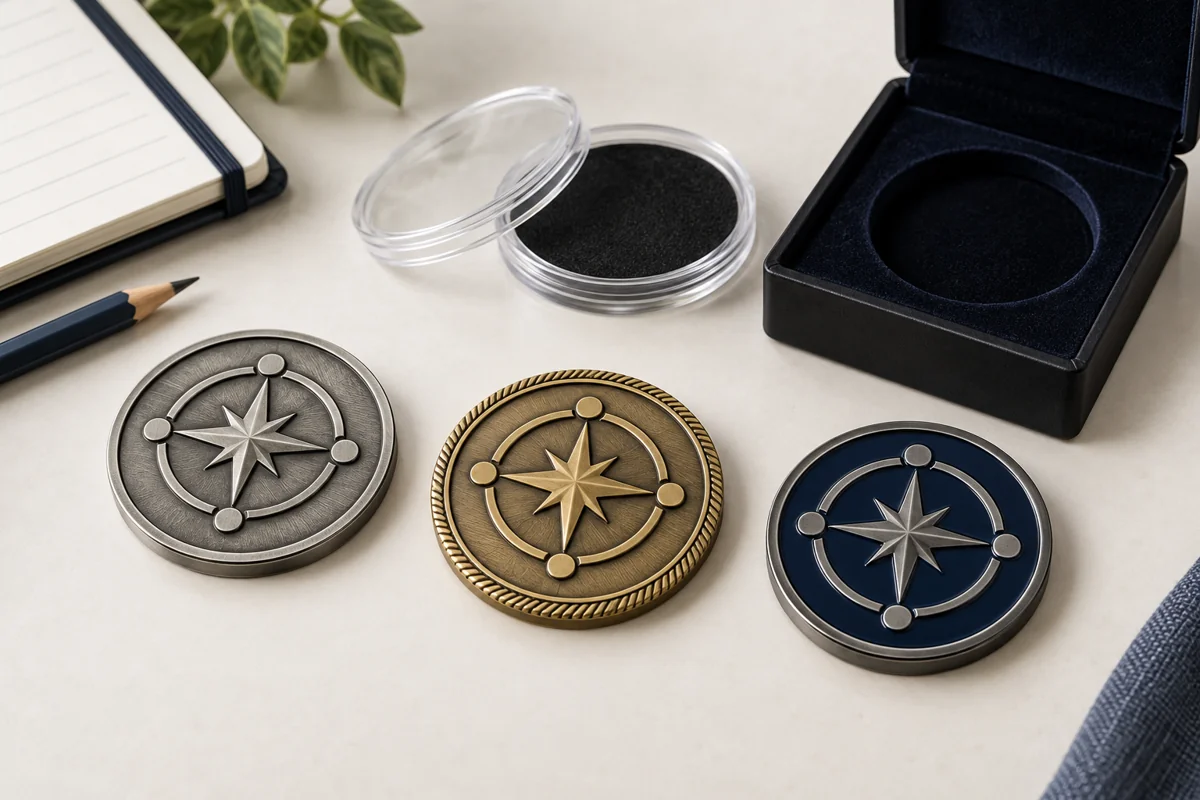
Polished gold, polished silver, black nickel and antique finishes change the contrast of an edge. A bright finish can make repeated cuts flash under light. An antique finish can emphasize recesses and make the relief read more strongly. A small catalog image in a different metal is therefore a poor basis for comparison.
Ask for shortlisted edges shown at the same diameter, thickness, viewing angle and plating. If the coin combines two-tone metal or color on the faces, check that the edge finish belongs to the same visual system.
4. Consider how the coin will be handled and presented
A coin carried in a pocket, exchanged at an event and handled frequently creates a different experience from one displayed in a capsule or presentation box. Deeper or more assertive textures will be noticed in the hand; fine reeding is subtler. Packaging should also accommodate the finished diameter and side profile without forcing the coin into an overly tight insert.
If tactile comfort, pocket carry or a fitted holder is important, request a physical sample with a comparable edge. A rendering can show the pattern, but it cannot fully communicate hand feel.
5. Confirm feasibility, price and lead time before approval
Do not assume every edge is available for every diameter, thickness, material or custom shape. Specialty edge work may affect the quote or schedule, but the impact depends on the construction and current production plan. Ask for that information while the artwork is still editable, not after the front and back have been approved.
The main custom challenge coins page lists available construction and finish choices. For unit-specific questions beyond the edge, use the military challenge coin design and ordering guide as a broader planning reference.
6. Require a side view on the proof
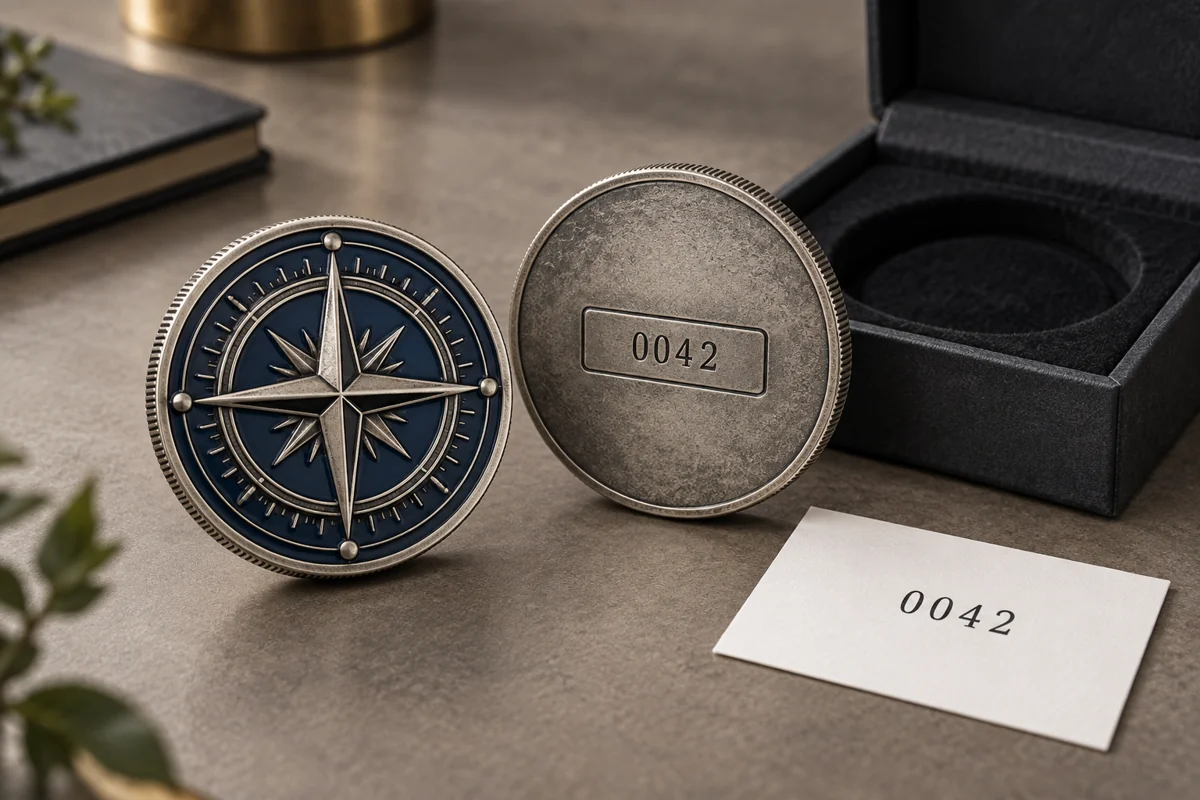
A top-down mock-up may barely show the edge. Ask for a labeled side view or angled rendering that includes the chosen pattern, plating and dimensions. The proof should also show the front and back rims so you can judge whether the side texture and face borders work together.
A simple three-option comparison test
Instead of reviewing twelve edges at once, ask for three purposeful candidates:
- A quiet baseline: standard or bezel.
- A restrained texture: reeded, cross-cut or oblique line.
- A thematic statement: rope, leaf, chain, spur or sunburst.
Place the three versions beside each other at the same scale. First view them as thumbnails and ask which coin has the clearest hierarchy. Then view the side profiles and ask which edge adds meaning without distracting from the emblem, wording or portrait. This comparison is more useful than choosing from unrelated sample photographs.
Edge ideas by coin purpose
Military and first-responder recognition
Standard, reeded, rope and spur edges can all work, depending on the unit identity and artwork. Let the emblem and outer-ring wording lead the decision. A highly detailed crest often benefits from a restrained edge; a simpler seal may support a stronger side texture.
Corporate milestones and employee awards
Standard, bezel, reeded and leaf patterns tend to provide a controlled, formal vocabulary. A sunburst can suit an anniversary or achievement theme when rays are not already dominating the faces.
Clubs, sports and enthusiast communities
Oblique lines can suggest movement without tying the design to a literal object. Bike-chain and chain patterns create a more specific reference for cycling, motorsport, engineering or team-unity concepts. Compare their scale carefully so the motif remains recognizable.
Maritime and heritage programs
Rope is an obvious candidate, but it should not be automatic. If the face already uses a rope border, consider standard or reeded edges to avoid repetition. If the face is minimal, the rope can provide the tactile cue that completes the theme.
Can decorative edges work on custom-shaped coins?
Sometimes, but not every pattern follows every contour cleanly. Tight inside curves, cut-outs, sharp corners and uneven thickness can limit how an edge treatment is applied. A pattern that is easy to read on a round coin may stretch, compress or stop awkwardly around an irregular silhouette.
Send the final outline early and ask which edges are feasible for that exact shape. If the edge is central to the concept, decide on it before committing to a complex silhouette.
Common mistakes when specifying a coin edge
- Using “edge,” “rim” and “border” as interchangeable terms. Label each area on the proof.
- Choosing from photographs with different plating and lighting. Compare like with like.
- Adding the edge after the face artwork is approved. The perimeter should be reviewed as one visual system.
- Matching the theme too literally. A thematic edge can become redundant when the same motif already fills the faces.
- Assuming every option works on an irregular shape. Confirm feasibility before the outline is locked.
- Reviewing only a top view. Require a side or angled view with the final dimensions.
What to include in the edge specification
- Coin diameter or full width and height for a custom shape
- Thickness and base material, if already decided
- Front and back artwork with the rim clearly identified
- Selected plating and any antique or polished finish
- First-choice edge plus one comparison option
- Intended use: pocket carry, presentation, exchange or display
- Packaging or fitted holder requirements
- Quantity, destination and required delivery date
For visual references, compare PinsCraftPro examples of a standard edge, rope edge, oblique-line edge, leaf edge, spur edge and sunburst edge. Use the product images to create a shortlist, then confirm the final appearance on an artwork-specific proof.
Challenge coin edge FAQ
What is the most traditional challenge coin edge?
Standard and reeded edges both produce familiar coin-like results, while bezel styles can add a clean finished transition. “Traditional” still depends on the organization, era and design language, so use the face artwork as the deciding context.
Does a decorative edge reduce the artwork area?
The edge and face rim are different parts, but the complete construction must be planned together. Some edge treatments or shapes may influence the practical perimeter and how close front or back details should sit. Confirm text clearance and the final face layout on the proof.
Is a rope edge only for naval coins?
No. Rope can also communicate connection, tradition or ceremony. It is simply most intuitive when the organization or story has a maritime relationship. Use it when it supports the message and does not duplicate an already busy rope border.
Do specialty challenge coin edges cost more?
They can affect pricing or production time, but there is no universal surcharge that applies to every coin. Diameter, thickness, material, quantity, finish and pattern all matter. Request a quote that lists the selected edge rather than assuming it is included.
Can the edge use a different plating from the faces?
Some constructions may support contrasting finishes, but feasibility and appearance must be reviewed for the exact design. Ask for an artwork proof that labels each metal finish and shows the transition clearly.
What should an edge proof show?
It should identify the edge by name, state the coin dimensions and plating, and include a side or angled view. Ideally, it also shows the front and back rims at the same time so the full perimeter can be evaluated.
Let the edge finish the story
A good edge is noticed twice: first as a subtle frame around the coin, and again when the recipient turns it in the hand. Start with the artwork rather than the edge catalog, compare a quiet option against a textured and a thematic option, and judge all three under the same plating and scale.
To compare edge treatments for your own artwork, begin with the custom challenge coins specifications and request side-view proofs for your shortlist. Include the coin’s purpose and packaging plan so the recommendation accounts for handling as well as appearance.